







Customer story · Brunswick Park Medical Practice · Southgate N11
Two days to a first draft. And everything either side of it.
Brunswick Park Medical Practice looks after around 8,570 patients in Southgate, north London. They first emailed us on 10 September 2024 and their new website went live on 21 October 2024, six weeks later. This is what a new practice website actually takes, told from the project record rather than from a brochure.
The practice was ready to move, and the pace was set from the first week: Steve Wheeler, who ran the build for us, had the first draft of the whole site in front of them twelve days after their first email. The review that followed took the time it needed. That time is the practice’s to take, and worth taking properly.
- Before the build 10 days 1 20 Sep 2024 The build starts
- The build 2 days 22 Sep 2024 First draft sent for review
- The review 24 days 2 16 Oct 2024 The review comes back
- Signed off and live 5 days 3 21 Oct 2024 Live
41 days from the practice’s first email to a live website, and two of them were the build. The rest was two organisations agreeing what to do, and then the practice checking that we had done it. No round of amendments waited more than a day.
10
days
Phase one 10 to 20 Sep 2024
Before the build
An enquiry, a meeting, eight questions and a decision. This is the part no supplier shows you, and none of it is design work.
10 days
10 Sep
2024
10 Sep 2024
Judy Wilson gets in touch.
Judy is the Operations Lead at Brunswick Park. Our reply went out at 13:44 the same day with a link to book a call, and she booked it at 15:52, about two hours later. Practices do not usually move that quickly, and it is worth saying why this one could: they had already worked out that their website needed replacing.
6
days
6 days. Finding a time that suited both diaries.
16 Sep
2024
16 Sep 2024
Thirty minutes, and a decision.
The meeting was booked for 11:30 and ran half an hour. The practice agreed to go ahead the same day. It was about whether we were the right people, not about whether the job needed doing. That distinction sets the pace more than anything we do.
2
days
2 days. Writing up everything we would need from them.
18 Sep
2024
Standards
18 Sep 2024 Standards
Everything we needed, in one email.
Steve Wheeler sent the practice everything he needed from them in a single email: eight numbered questions covering content, documents, form notifications, search, social media, the logo, a design they liked and a photograph of the practice. The sooner the practice had the questions, the sooner they could start on the part only they could do.
Question two is the one worth pausing on, because this is where the standard we hold the site to begins to shape the work, before any of it is built. We do not put documents on a practice website unless they meet the accessibility standard: a PDF that a screen reader cannot read is not information, it is a picture of information, and a site full of them fails its patients and can put the practice on the wrong side of the law. Where we can, we rebuild them as ordinary web pages instead.
Judy replied within the hour. Some answers needed the practice’s own management meeting, so that came first. This entry is the first of three on this record tagged Standards: the decisions that kept the site to the accessibility standard before anyone tested it.
1
day
1 day. The practice management meeting.
19 Sep
2024
19 Sep 2024
Agreed, paid, and under way.
That meeting settled the last of the answers, the build was paid for, and Steve wrote back the same evening to confirm who he would need for sign-off, so nothing would be waiting at the end.
Everything was now in place, with a brief on its way. It arrived the next day, which is where phase two begins.
1
day
1 day. The practice writing its content brief.
20 Sep
2024
20 Sep 2024
1 Build starts
One evening, twelve decisions.
Before a single page can be built, somebody at the practice has to go through the old website and decide what deserves to survive. Judy did all of it before a fortnight of annual leave she had already booked, so the leave would not hold anything up. Here is what she sent, in the order she sent it.
- 01 The coronavirus help centre Removed
- 02 A “specialists recommended” section Removed
- 03 The third-party self-help resources Removed
- 04 Patient testimonials Removed
- 05 The health champions page Removed
- 06 A “we need you” patient-group appeal Removed
- 07 The online registration form Removed
- 08 A temporary registration form Removed
- 09 A doctor who had left the practice Removed
- 10 Social prescriber self-referral Kept
- 11 A receptionist who had joined Added
- 12 The published GP earnings figure Updated
9 of the 12 were deletions. A new website is mostly deciding what to leave behind.
2
days
Phase two 20 to 22 Sep 2024
The build
Two days from the practice’s brief to a complete first draft they could click through.
2 days
2 days of build. Steve at work on the site, from the brief arriving to the first draft going back.
22 Sep
2024
22 Sep 2024
Ready to review, twelve days in.
The first draft was the whole website: every page, the practice’s own photograph on the front, and the twelve decisions applied.
Judy’s annual leave had started by then, so an automatic reply came back. She looked at the draft anyway, two days later.
24
days
Phase three 22 Sep to 16 Oct 2024
The review
The longest phase, and the one that matters most: a practice website has to be checked by the practice, page by page.
24 days
2
days
2 days. The draft sitting with the practice.
24 Sep
2024
24 Sep 2024
A first look, and a first reaction.
“I didn’t expect to hear from you so quickly.”
20
days
20 days. The draft still with the practice.
14 Oct
2024
14 Oct 2024
We write to ask how it is going.
With the draft sitting ready and the practice busy, Steve wrote to ask whether he could take any of it off their hands. Nobody had asked him to. A practice with a website waiting on its review has one more thing on its list, and the quickest way to close it is usually to offer to help rather than to wait.
2
days
2 days. Judy back at her desk and working through it.
16 Oct
2024
Standards
16 Oct 2024 Standards
2 Review back
The review comes back.
Her answer explained the quiet stretch better than we could have:
“I had 2 weeks leave and planned to work on it but didn’t realise how much I needed the time off until I was off. The new website looks great, thank you.”
Her review listed six items. All six were done and sent back in under three hours:
- The integrated care board contact details
- A postcode boundary checker on the registration page
- Staff photographs and qualifications
- Support for carers on the services page
- The social prescriber self-referral she had asked to keep
- A long-term conditions page, built from scratch
That first one is not a design request, it is a compliance one: practices have to publish their integrated care board contact details, one of the checks in NHS England’s GP website benchmarking tool. Judy did not have to explain what it was or where it belonged. A supplier who does not work in general practice would have needed telling.
5
days
Phase four 16 to 21 Oct 2024
Signed off and live
A partners’ meeting, a second list of amendments answered within a day, a final read, and a domain move.
5 days
1
day
1 day. Before the partners’ meeting.
17 Oct
2024
17 Oct 2024
The GP partners see it.
Judy took the site to the practice’s GP partners and came back with a second list of amendments, and a line worth more than the list:
“They are very pleased with the website.”
1
day
1 day. Steve working through the second list.
18 Oct
2024
Standards
18 Oct 2024 Standards
The second list, and the awards made readable.
The whole list was done by that afternoon. A dementia-friendly statement added, a travel vaccination link pointed at the right page, a home visits page reworded.
The practice has won awards, and the first thought was to add the certificates as pictures. Text inside an image cannot be read by a screen reader, and cannot be translated for a patient who reads in another language, so the awards went on as real words instead, with the reasoning shared so the choice was made together. The practice keeps every bit of the credit, and now all their patients can read it.

3
days
3 days. The practice’s final read before going live.
21 Oct
2024
14:55
21 Oct 2024 · 14:55
3 Live
Live.
“Thanks Steve! You have done a great job. We are happy to go live!”
Go-live took an afternoon. Moving a practice website onto its NHS domain is not ours to do: it goes to NHS England’s DNS team, and normally takes a few working days. On this afternoon, everything landed inside two hours.
- 13:13 The practice confirms it is happy to go live, with two last items
- 13:23 Both done, and the NHS domain change requested
- 13:58 NHS England confirm the change, thirty-five minutes after it was asked for
- 14:55 The new website is live
- 15:24 Judy spots a member of the reception team missing from the staff page
- 15:33 Fixed
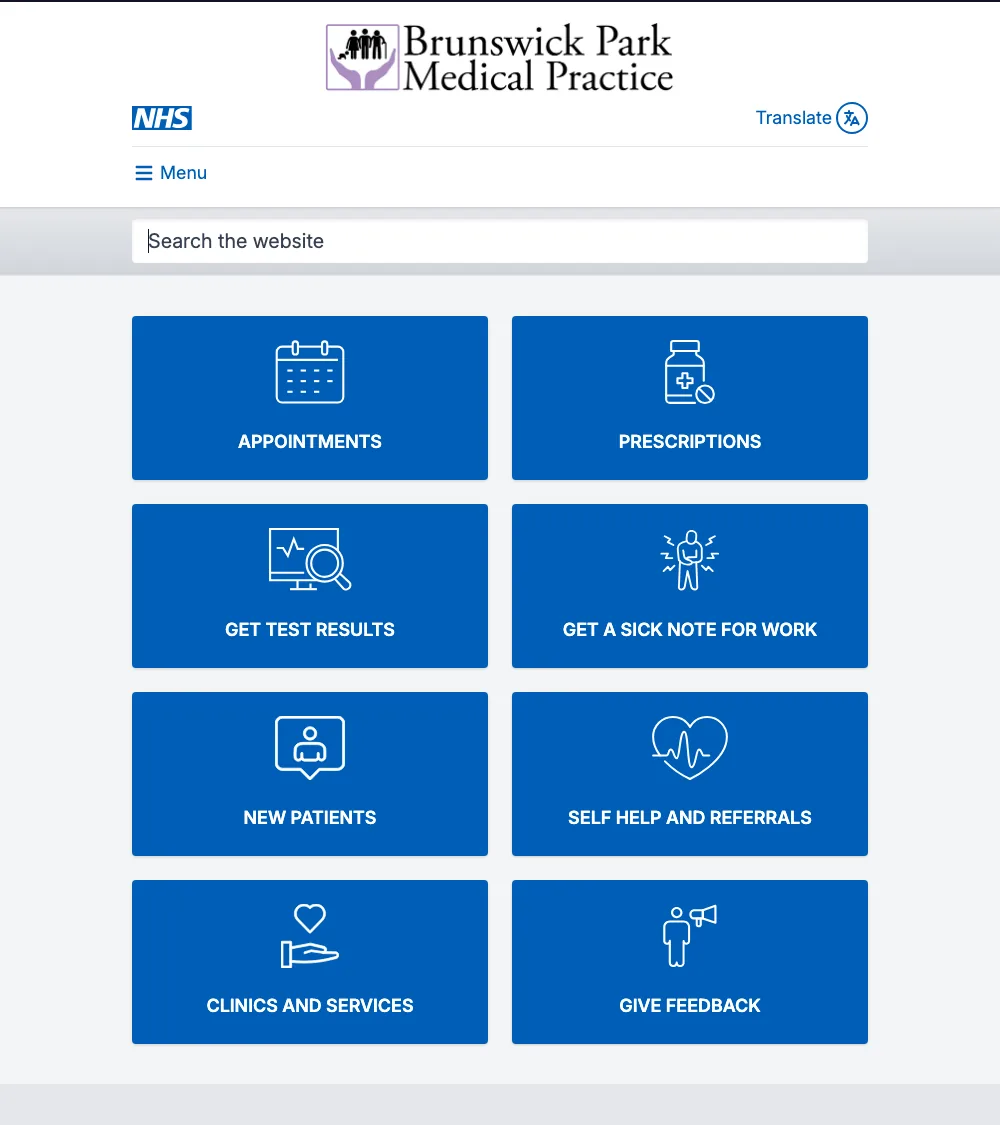
That is the shape of nearly every website project we run. The pace is set by how quickly a practice can answer questions about its own content, which is why the ones that move fastest are the ones that, like Brunswick Park, had already decided their website needed replacing before they picked up the phone.
Afterwards
Nearly two years of living with it
A website proves itself after launch, when nobody is admiring it any more. Here is what has happened since.
Since
2024
Since 2024
About one email a month.
25 requests in the 21.7 months since. Three of them, with their dates:
- Sep 2025 A link changed for blood test appointments
- Mar 2026 The published GP earnings figure, again
- Aug 2026 A practice event announced to patients
The March 2026 one is decision twelve from the brief, come round again. Nearly two years on, the practice is still doing the job it did in that one-evening brief: deciding what patients need to see, and sending it over.
“They came straight back with a friendly email to advise all has been complete, and links to easily see the changes. Fabulous experience every time.”
13 Aug
2026
Standards
13 Aug 2026 Standards
Still standing up to the test.
Nearly two years on, the live site scores 100 out of 100 for accessibility, 100 for best practices and 100 for SEO. All 27 automated accessibility checks pass. The scores come from Google Lighthouse 13.4.1, measured against the live site on 13 August 2026.
That is not luck, and it is not something we went back and fixed for the test. It is the result of the three decisions marked Standards earlier on this record: the documents rule applied before a page was built, the benchmarking detail added within three hours of being asked for, and the award images turned down. Every practice website we build is held to WCAG 2.2 AA, and the work that gets it there mostly happens in small decisions like those.
No automated test can certify a site as fully accessible: a further set of checks in that suite can only be judged by a person, and a clean automated pass is the floor, not the ceiling.
Written by Paul Chapman, Managing Director of Tree View Designs.
Every figure on this page was taken from our own project and support records, NHS Digital's published list size, and an independent automated test of the live site, and checked on . Counts leave out the tickets our own systems raise automatically, so the totals are only the requests the practice actually sent, and lower than the raw numbers in our system. Support figures change as we keep working, so later numbers will differ.
The first move is yours.
If your practice has already decided its website needs replacing, the rest is quicker than you think. For Brunswick Park it was one evening of decisions to write the brief, and two days from the brief to something they could look at.
Or see how we design and build GP surgery websites, or start with a free audit of your current site.