
Your practice website is not just a marketing tool. Under the GP contract, it is a regulated channel for patient access, information, and communication. Getting it wrong does not just frustrate patients—it creates compliance risk that can surface during CQC inspections, ICB reviews, or patient complaints.
This article sets out what your GP practice website must include, what practices most commonly miss, and how to stay on the right side of the requirements.
Why website compliance matters
The GP contract, the Public Sector Bodies Accessibility Regulations, and CQC inspection frameworks all place obligations on what a practice website must contain and how it must function. These are not suggestions—they are enforceable requirements.
- CQC inspections assess whether patients can access the information they need. Inspectors routinely check practice websites as part of the “responsive” and “well-led” key lines of enquiry.
- ICB oversight monitors contract compliance, including whether practices meet their website obligations under the GMS, PMS, or APMS contracts.
- Patient complaints about being unable to find information, register, or access services online are taken seriously and can escalate to the Parliamentary and Health Service Ombudsman.
A non-compliant website is not a minor administrative gap. It is a visible, documented failure that patients, commissioners, and regulators can all identify.
Mandatory content: what your website must include
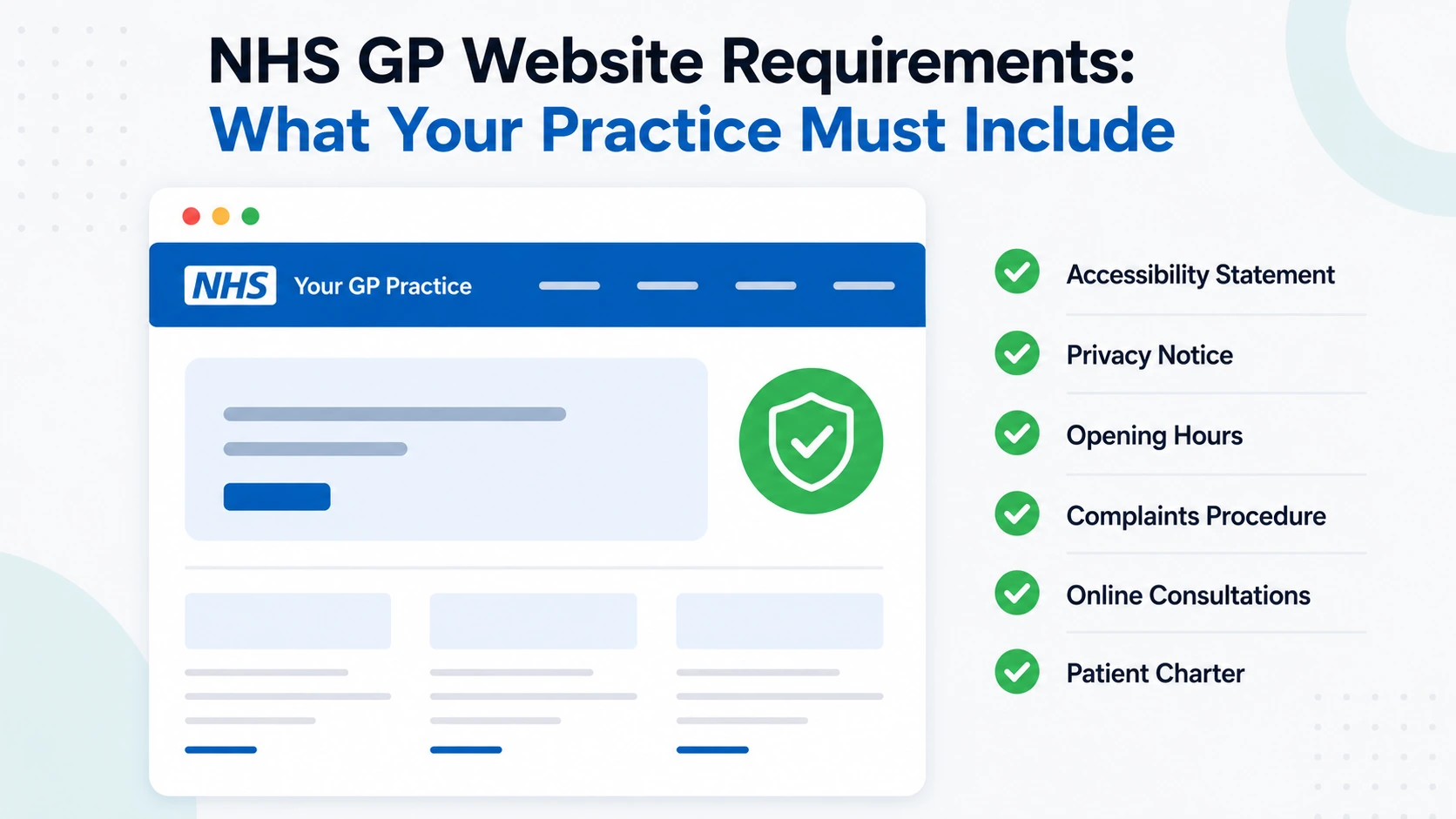
The following information must be published on your practice website. This list draws from the GP contract, NHS England guidance, and CQC expectations.
Practice details
- Practice name, address, and full contact details (telephone, email where applicable)
- Opening hours, including any extended access or enhanced hours arrangements
- Out-of-hours information—what patients should do when the practice is closed
- Practice area or boundary map
Staff and clinical information
- List of GPs and their registration status (including performer list number)
- Named GP for patients aged 75 and over
- Details of other clinical staff (nurses, pharmacists, healthcare assistants)
- Information about any trainees or locum doctors working at the practice
Patient services
- How to register as a new patient, including online registration or downloadable forms
- How to book, change, or cancel an appointment
- How to order repeat prescriptions
- How to request a sick note (fit note)
- How to access test results
- Information about available services (cervical screening, vaccinations, chronic disease management)
Online access
- Online consultation tool available during core hours (8am–6.30pm, Monday to Friday) —a contractual requirement since 1 October 2025
- Link to or information about the NHS App for appointment booking, prescriptions, and record access
- Link to the “You and Your General Practice” patient charter—a contractual requirement since October 2025
Complaints and feedback
- Complaints procedure—how patients can raise a complaint and who handles it
- Friends and Family Test—how patients can provide feedback
- Details of the named complaints manager and responsible person
- Information about escalating to the Parliamentary and Health Service Ombudsman if unresolved
Legal and regulatory pages
- Privacy notice explaining how patient data is collected, stored, and shared
- Accessibility statement describing WCAG 2.2 AA compliance status, known issues, and how to report accessibility problems (required under the Public Sector Bodies Accessibility Regulations 2018)
- Cookie policy, and a compliant cookie consent mechanism
- How patients can make a subject access request to see their own health records
Common gaps: what practices most often miss
After reviewing hundreds of GP practice websites, the same gaps appear repeatedly:
Missing accessibility statement
This is the single most common compliance failure. The regulations require every public sector website to publish an accessibility statement. It must describe the website’s current compliance level, list known issues, and provide contact details for reporting problems. Many practices either have no statement at all or have a generic template that does not reflect their actual website. Our guide to WCAG 2.2 compliance for GP practice websites explains what a meaningful accessibility statement should cover.
Named GP for over 75s
Since 2014, every patient aged 75 and over must have a named accountable GP. This information should be easy to find on the website, yet many practices bury it deep in a policy document or omit it entirely.
Out-of-hours information
Patients need to know what to do when the practice is closed. A surprising number of websites either have no out-of-hours information or display it only on an “About Us” page that patients are unlikely to visit in an emergency. This information should be prominent—ideally on the homepage or in the site header.
Complaints procedure
CQC expects the complaints procedure to be readily accessible. A PDF buried in a policies section does not meet this expectation. The procedure should be a clearly labelled web page, reachable within one or two clicks from the homepage.
Outdated content
Clinician lists that include GPs who left years ago, opening hours that do not reflect current arrangements, and vaccination information from previous campaigns all undermine patient trust and create compliance risk. Content should be reviewed on a regular cycle—quarterly at minimum.
How Tree View Designs ensures compliance
Every website we build includes all mandatory content pages as standard, structured and linked so that patients can find them within one or two clicks:
- Practice details, staff list, and opening hours in a consistent, maintainable format
- Dedicated pages for complaints, privacy, accessibility, and registration
- Prominent out-of-hours information accessible from every page
- Online consultation integration that meets the October 2025 contractual requirements
- Patient charter link (“You and Your General Practice”) embedded where patients will see it
For Premium customers, we provide active compliance monitoring. When contractual requirements change—as they did in October 2025—we update your website proactively rather than waiting for you to notice.
Check your website today
Open your practice website on your phone. Can you find each of the items listed above within two clicks? Is the information accurate and up to date? Is the accessibility statement present and does it describe your actual website?
If the answer to any of those questions is no, your website has compliance gaps that could surface at your next CQC inspection or ICB review. For a structured way to assess your site against the tasks patients perform most, see our guide to the NHS GP Website Benchmarking Tool.
Not sure where your website stands? Get in touch for a compliance check and a clear picture of what needs fixing.