







Choosing a website provider for your GP practice is not a decision to take lightly. Your website is often the first touchpoint for patients—the place they go to book appointments, order prescriptions, find your phone number, and access services. A poor website affects patient access, satisfaction scores, and regulatory compliance. A good one quietly does its job every hour of every day.
This guide sets out the criteria that matter most when evaluating GP website providers, the questions you should ask, and the red flags that suggest a provider may not be the right fit.
Key Criteria to Evaluate
1. NHS Compliance
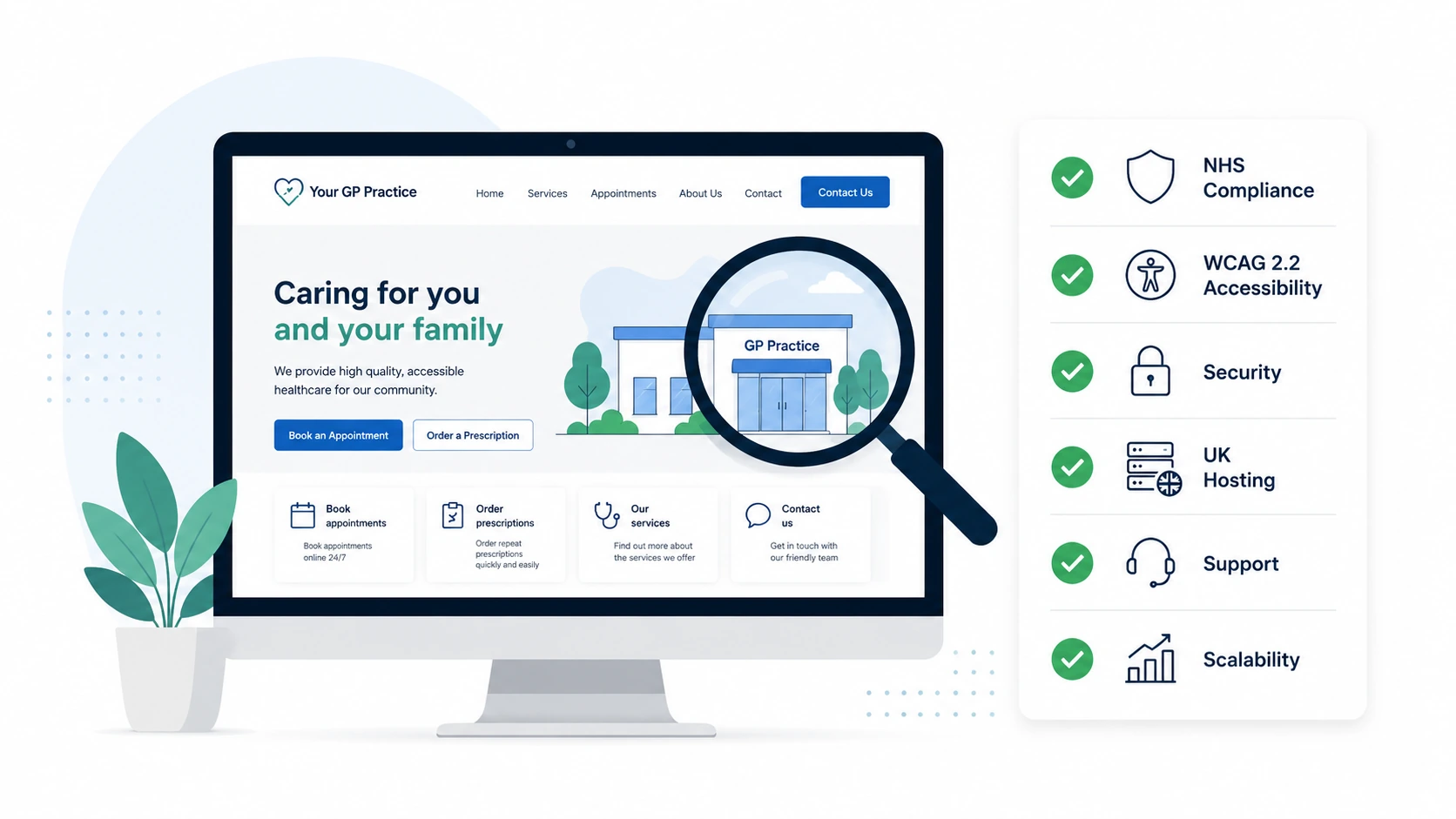
Your website must meet specific contractual requirements under the GP contract, and it must comply with the Public Sector Bodies Accessibility Regulations 2018 at WCAG 2.2 AA level. Any provider you consider should be able to demonstrate:
- Familiarity with the NHS GP Website Benchmarking Tool and its 50 criteria
- Built-in WCAG 2.2 AA accessibility, not bolted on afterwards
- Templates that include all mandatory content pages as standard
- An understanding of what CQC inspectors look for when they review a practice website
If a provider cannot explain how their platform meets the benchmarking tool criteria or what WCAG level they target, that is a significant concern.
2. Security and Data Protection
GP practice websites handle sensitive patient interactions. The provider’s security posture matters:
- UK-based hosting: Patient data should be processed and stored on servers located in the United Kingdom. Offshore hosting introduces data residency risks and may not comply with NHS data protection standards.
- SSL encryption: Every page should be served over HTTPS. This is a baseline requirement, not a premium feature.
- Regular backups: The provider should maintain automated backups with a clear recovery process. Ask how frequently backups run and how quickly they can restore your site.
- Security patching: The underlying platform must receive regular security updates. Ask whether patching is included in the support agreement or charged separately.
3. Support Model
The quality of ongoing support is often more important than the initial build. Key questions:
- Response times: What is the guaranteed response time for support requests? Is there a difference between urgent and routine issues?
- Helpdesk system: Does the provider use a proper ticketing system with tracking, or do they rely on email and hope? A helpdesk provides accountability and audit trails.
- UK-based support: Will you speak to someone who understands the NHS context, or will you be routed to a generic overseas support team?
- Proactive monitoring: Does the provider actively monitor your site for downtime, broken links, and expiring certificates, or do they wait for you to report problems?
4. Content Management
Practices need to update content regularly—staff lists, opening hours, service information, news items. Understand how this works:
- Self-service vs managed: Can you make simple content changes yourself, or does every update go through the provider? Both models work, but the implications for speed and cost are different.
- Training: If you will be managing content, does the provider offer training and documentation?
- Content updates in support: If content changes are managed by the provider, how many are included in your support agreement? What happens when you exceed the allowance?
5. Scalability
If your practice is part of a Primary Care Network or a multi-site group, consider whether the provider can support that:
- Can you manage multiple practice websites from a single dashboard?
- Is there consistency of design and navigation across sites?
- Can group-wide updates (such as policy changes or vaccination campaigns) be applied once and rolled out to all sites?
6. Total Cost of Ownership
The cheapest quote is rarely the cheapest option over three to five years. Consider the full picture:
- Setup fee and ongoing monthly or annual costs
- What is included in the support agreement and what is charged as extra
- Cost of content updates, form creation, and design changes
- Whether a website refresh or rebuild is included in the contract cycle
- Exit costs—what happens if you want to leave? Do you own your content?
Questions to Ask Every Provider
When speaking to potential providers, these questions will quickly reveal the quality of what they offer:
- “Do you score your websites against the NHS GP Website Benchmarking Tool?”
- “What WCAG level do your websites meet, and how do you verify that?”
- “Where are your servers physically located?”
- “What is your average response time for support requests?”
- “How are security patches and platform updates handled?”
- “Can I manage multiple practice websites from one account?”
- “What happens to my content and domain if I leave?”
- “Is a website refresh included in the contract, and how often?”
- “How do you handle NHS contractual changes—do you update proactively or wait for me to ask?”
A provider that can answer all of these clearly and confidently is worth serious consideration. Vague or evasive answers are a signal to look elsewhere.
Red Flags to Watch For
Not every provider that targets the NHS market delivers to NHS standards. Watch for these warning signs:
- Offshore hosting with no clear explanation of where patient data is processed
- No accessibility statement on the provider’s own website—if they do not practice what they preach, they are unlikely to prioritise it for your site
- No security patching included in the agreement, or patching offered only as a paid add-on
- Long lock-in contracts with no refresh or rebuild cycle—your website will look dated within two to three years
- No helpdesk or ticketing system—support via email alone provides no accountability
- Template-only approach with no ability to customise forms, navigation, or content structure to your practice’s specific needs
- Inability to explain how they meet the NHS benchmarking tool criteria or WCAG standards
Making Your Decision
The right provider is one that understands the NHS context, builds compliance into their platform from the start, provides responsive and knowledgeable support, and treats your website as a living service rather than a one-off project.
Price matters, but it should not be the deciding factor. A website that is cheap to build but expensive to maintain, difficult to update, or non-compliant with NHS standards will cost your practice more in the long run—in staff time, patient frustration, and regulatory risk.
Take the time to evaluate properly. Ask the hard questions. Compare answers side by side. The decision you make will shape how patients experience your practice online for years to come.
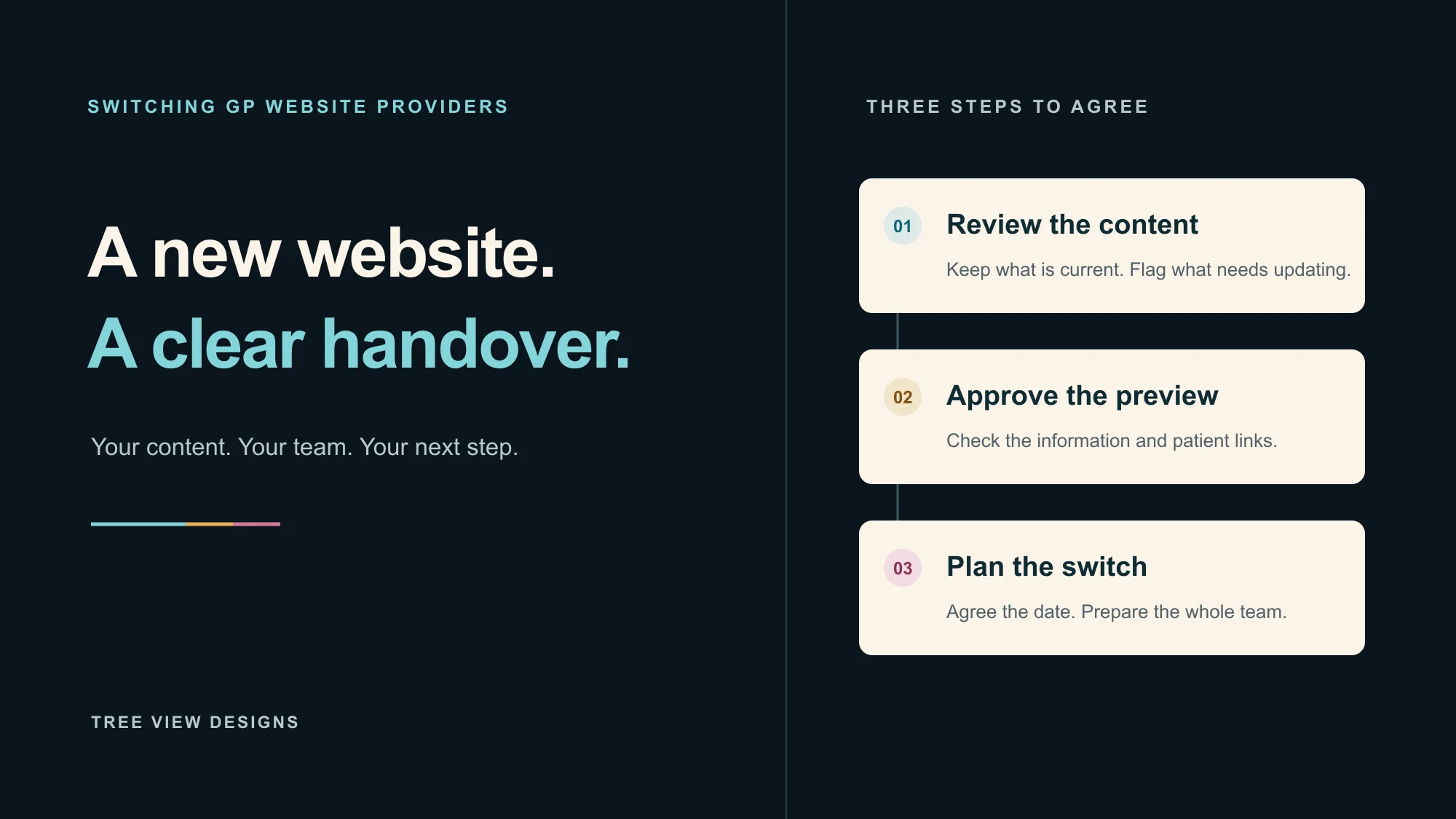
If you are reading this because My Surgery Website is winding down, the decision has a deadline attached: MSW practices need to instruct where their domain goes by 1 September 2026. We have set out those dates, and what a managed move involves, on our My Surgery Website transition page.
Ready to compare? Get in touch for an honest conversation about your options.