







The tools are genuinely impressive. Type a sentence into an AI website builder like Lovable, Wix, or even ChatGPT, and within minutes you have a clean, modern-looking GP practice website on your screen. We’re increasingly hearing from practices who have done exactly that, then held the result up against their current site and asked a reasonable question: “This looks better. Why are we paying for the other one?”
It’s a fair question, and it deserves an honest answer. The short version is this: a GP practice website that looks finished and a GP practice website that is legally compliant and properly maintained are two very different things. The design is the easy part. Everything underneath it, and everything that happens after launch, is where a practice website actually earns its keep. That is precisely the part these tools don’t do.
What an AI builder actually gives you
AI website builders are designed to do one thing very well: generate a front-end design. They produce the visible layer, the layout, the colours, the words on the page. What they are not designed to give you is everything a working practice website depends on:
- A content management system your team can safely use to update opening hours, staff lists, and policies, without touching code or breaking the page.
- Secure, UK-based hosting appropriate for an NHS service, with SSL, automated backups, and a clear recovery process.
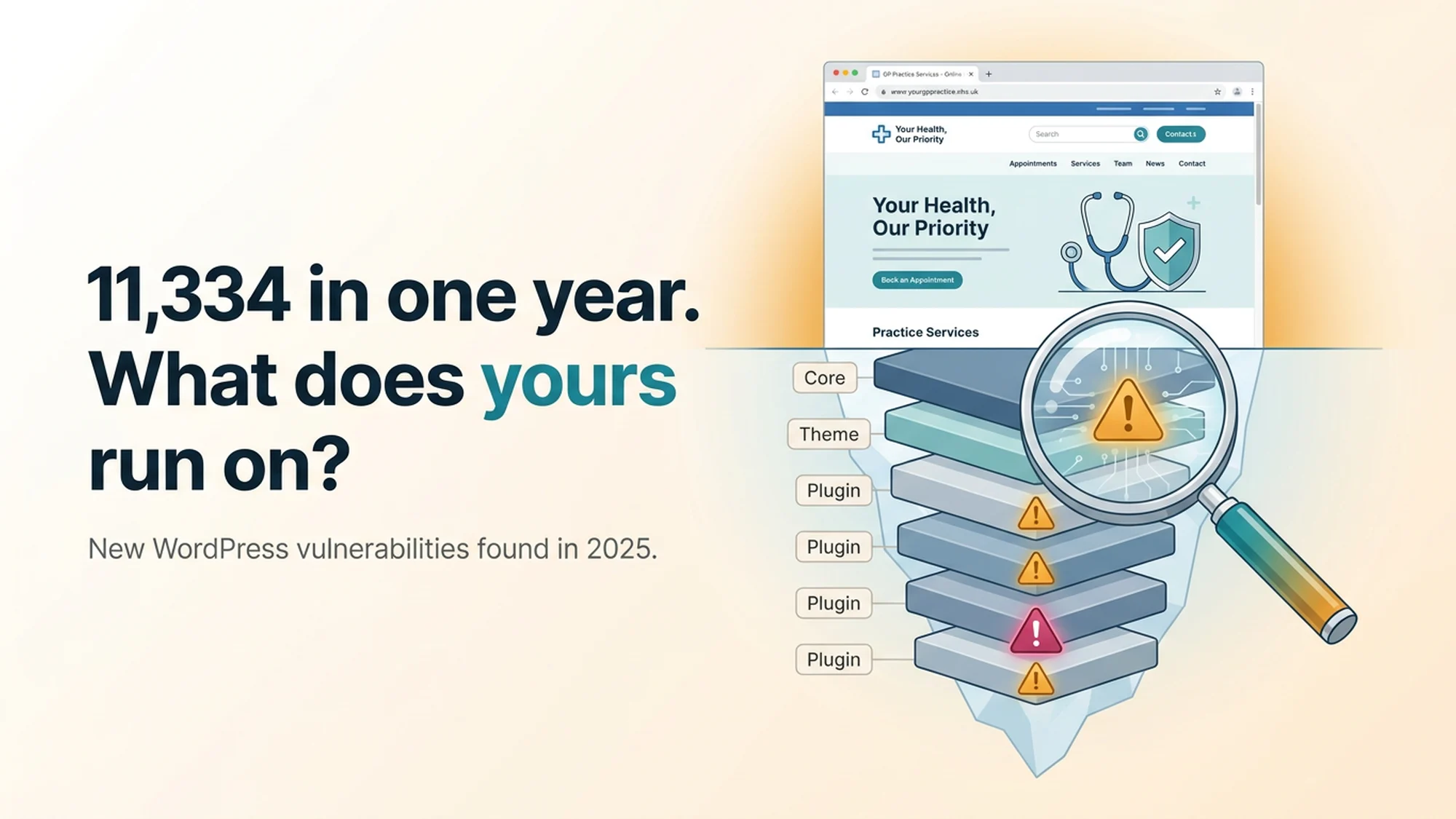
- Ongoing security patching to keep the site safe as new vulnerabilities emerge. A website is not a leaflet; it needs maintaining every month it’s live.
- Specialist support from people who understand the NHS context when something goes wrong, or the rules change.
A generated design is a starting point, not a finished service. And for a GP practice, the gap between those two things is not a matter of polish. It’s a matter of law.
A GP website is a public service, with legal duties attached
Your practice website is not a marketing brochure. It is a public sector digital service, and that brings legal obligations that apply whether the site was built by a specialist, a staff member, or an AI tool.
Under the Public Sector Bodies (Websites and Mobile Applications) Accessibility Regulations 2018, your website must meet the Web Content Accessibility Guidelines (WCAG) 2.2 to level AA and publish a compliant accessibility statement. GP practices are not exempt from this. As NHS England puts it plainly, NHS services must meet the guidelines to level AA “for all patient and staff facing services.”
Accessibility is only the legal baseline. On top of it, a GP website has to satisfy the contractual obligations of the GP contract, which is exactly what NHS England’s GP Website Benchmarking and Improvement Tool assesses, across patient journeys, practice manager priorities, and legal requirements. The GP contract itself requires practices to have an online presence “which they keep up to date.” There is a specific list of content every practice site must carry, and it changes as NHS guidance evolves.
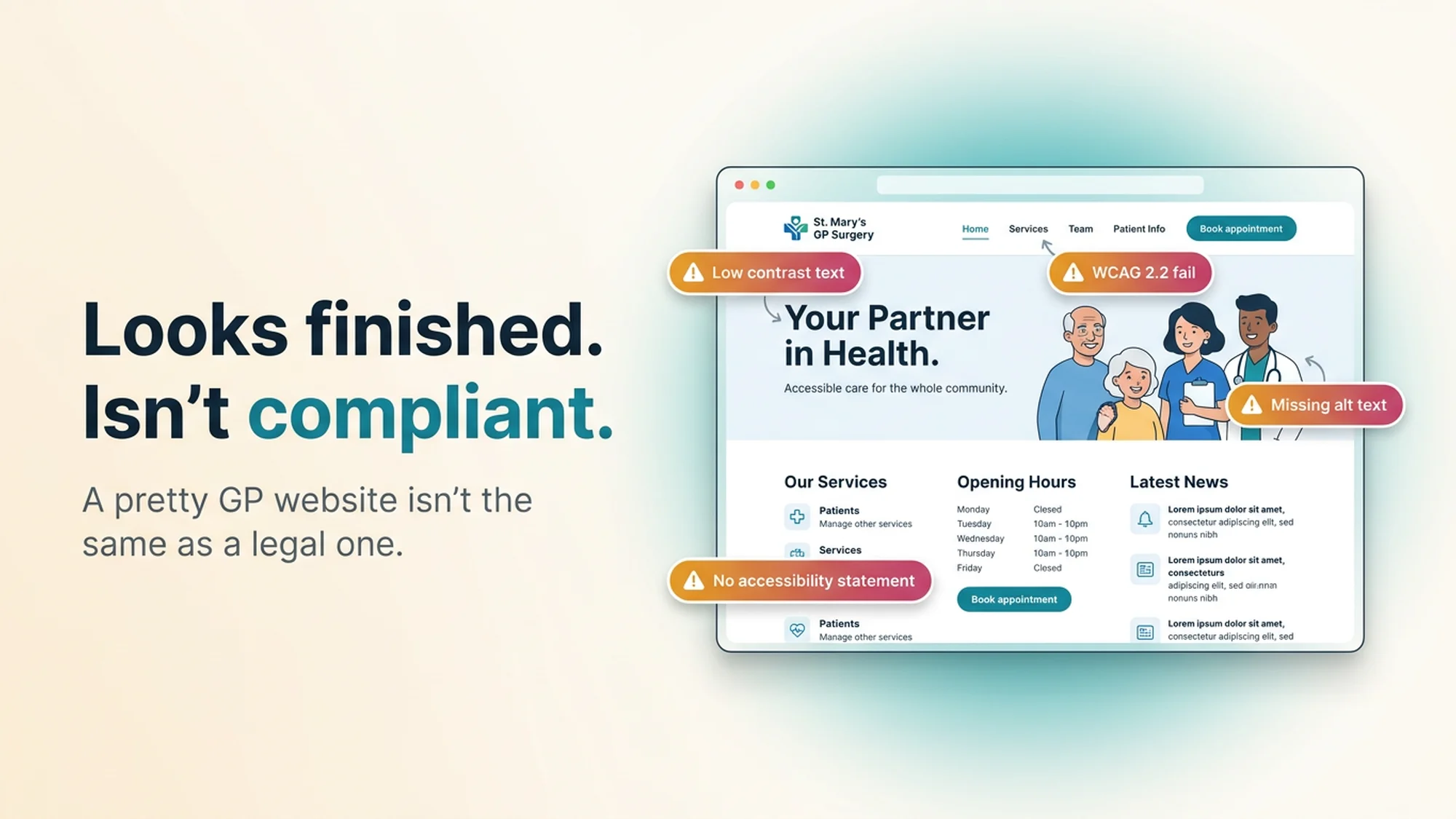
None of this is visible in a design. An AI builder has no way of knowing that your appointment information needs to meet a benchmarking criterion, that your colour choices have to clear a contrast ratio, or that your accessibility statement has to exist at all. It produces something that looks right. Looking right and being compliant are not the same test.
The fact that changes the whole decision
Here is the part that surprises most practices, and it’s worth reading twice. You cannot hand the legal responsibility to whoever (or whatever) built your site. Both NHS England and the Government Digital Service state it directly: you are legally responsible for your website meeting accessibility requirements, even if you have outsourced it to a supplier.
Read that against a do-it-yourself build and the logic inverts. Building your own website doesn’t avoid the risk. It keeps the full legal responsibility with the practice while removing the one thing that manages it: specialist expertise. If the site falls short, the practice is the body in breach of the Equality Act 2010, which the Equalities and Human Rights Commission can enforce through investigations, unlawful act notices, and court action. The tool that generated the design carries none of that. You do.
Compliance is hard, and it is routinely got wrong
This isn’t a theoretical risk that only catches the careless. Getting accessibility right is genuinely difficult, and the evidence shows how often it’s missed, even by organisations trying hard.
A 2023 audit of 50 UK GP website homepages by the accessibility consultancy Nexer Digital found that two-thirds (66%) had detectable WCAG failures, and almost two-thirds (62%) had low-contrast text. The most common accessibility failures across the web as a whole (low-contrast text, missing image descriptions, and unlabelled form fields) are precisely the kind of errors a generated or hand-built site introduces without anyone realising. WebAIM, which tests a million home pages every year, found in 2026 that 95.9% had detectable failures, and noted the trend likely reflects growing reliance on automated and AI-assisted coding.
And compliance is never a one-off. Government monitoring of public sector websites between 2022 and 2024 identified nearly 30,000 accessibility issues, of which only 55% were fixed, and only 8% of accessibility statements were fully compliant when first checked. If well-resourced public bodies under formal monitoring struggle to keep up, a single practice maintaining a self-built site in spare moments has little chance of staying compliant for long.
The honest difficulty is knowing where you actually stand, because most of these problems are invisible until someone tests for them. That’s exactly what our free website audit is for: it checks your current site against the NHS GP benchmarking criteria, WCAG 2.2 accessibility, reading age, performance, link health, and security, then sends you a plain-English report on where it passes and where it falls short. It works no matter who built your site, and there’s no obligation attached.
And compliance still isn’t the same as usability
Here is the part that’s even harder for an AI tool to grasp than the legal checklist. Meeting WCAG 2.2 is a floor, not a finish line. A website can pass every automated accessibility check and still be confusing, intimidating, or simply unhelpful to a real patient. Compliance proves the page is technically sound. It doesn’t prove the page actually works for the person in front of it.
Genuine accessibility and usability aren’t boxes to tick. They’re about understanding how patients really think and behave: the anxious parent trying to get an urgent appointment at 8am, the 80-year-old ordering a repeat prescription, the person with low digital confidence or English as a second language trying to register. A patient like that doesn’t move through a website the way its layout assumes. They scan, they hesitate, they get lost, and when the site doesn’t make sense, they give up and phone the practice instead.
This is where AI builders and DIY tools fall down hardest. They are built to produce something that looks like a website and, at best, passes a technical check. They have no sense of the patient mindset, the real journeys a GP website has to carry, or the small design decisions that decide whether someone completes a task online or reaches for the phone. It’s precisely why NHS England’s benchmarking tool measures real patient journeys, not just whether the code is clean.
Understanding that mindset is human work, and it’s exactly what a specialist team is for. It comes from years of building NHS GP websites, watching how real patients use them, and shaping each journey around the people who find it hardest: the worried, the rushed, the less confident, the ones for whom English is a second language. A good team sits with a practice, asks who its patients actually are, and designs around how they genuinely behave. Knowing where a link needs to sit, how much to say, and what to make impossible to miss is judgement built on experience, and it’s the part of the job an AI tool has no way of doing.
And this is where it comes back to the practice. A website patients can’t navigate doesn’t lighten your workload, it adds to it. Every patient who can’t find the prescription line, can’t work out how to register, or abandons the online form becomes a call your team has to take. A website that doesn’t understand patients doesn’t support the practice. It quietly works against it.
The hidden cost: it is your team’s time, forever
“Free” website tools are not free. The cost simply moves from an invoice to your payroll, and it never stops arriving.
Every content change, whether that’s bank holiday hours, a new clinician, a flu campaign, an updated privacy notice, or an accessibility fix, becomes a task for someone at the practice. That someone has a salary. For context, NHS Agenda for Change pay bands (a useful benchmark, though practice staff are employed directly by the practice rather than on Agenda for Change terms) put a senior administrator at Band 4, roughly £27,000 to £30,000, and many practice managers around Band 6, roughly £39,000 to £47,000, in 2025/26. Every hour spent wrestling with a website that no longer behaves, or chasing an accessibility problem nobody on the team is trained to diagnose, is an hour not spent on the work only they can do.
It is rarely the headline build that costs the most. It is the slow, permanent drip of maintenance: the part the demo never shows you, and the part the AI tool walks away from the moment the design is done.
And what happens when that person leaves?
There is one more risk we see again and again, and it’s the one practices almost never plan for. A self-built website usually lives in a single person’s head. They know the logins, the quirks, how to make a change without breaking the layout, which plugin does what. The site works because they are there.
Then they leave, and the knowledge leaves with them. We have lost count of the practices who built their own site, lost the person who understood it, and found themselves with a website nobody can safely touch: out-of-date content, an expired certificate, an accessibility statement frozen in time, and no one who dares change a thing. A surprising number of them come back to us to put it right. The DIY route didn’t save money; it deferred the cost and added a rebuild on top.
What you’re actually paying a specialist for
When you work with a specialist NHS GP website provider, the design is the part you can see, but it’s the smallest part of what you’re buying. The rest is everything the AI builder can’t give you:
- People who understand your patients, not just the rules. A team that shapes each journey around how real patients behave, from the anxious and the rushed to those with low digital confidence, so the site genuinely lightens your workload instead of adding to it.
- A platform built to meet WCAG 2.2 AA and the GP Website Benchmarking criteria from the start, not bolted on afterwards.
- The mandatory content pages and accessibility statement included as standard, and kept current as NHS guidance changes.
- Secure UK hosting, security patching, and backups maintained for you, every month the site is live.
- A specialist support team who know the NHS context, so a change request is a quick email, not a staff project.
- Continuity that doesn’t depend on one person staying. When your team changes, your website doesn’t fall over.
A good-looking website is genuinely easy to produce now, easier than it has ever been. That is exactly why looks are no longer the thing that matters. The question for a GP practice was never “can we make something that looks nice?” It’s “can we keep a compliant, secure, accurate public service running, every day, for years, no matter who’s on the team?” That is the job. It’s the one we built our whole company around, and the one an AI tool was never designed to do. It’s also why we built our own platform from scratch rather than relying on generic tools ourselves.
So if you’re weighing up building your own website against working with a specialist, start by finding out where your current site really stands with a free website audit. And if you’d like to talk it through honestly, with no hard sell, get in touch. We’re always happy to help.