








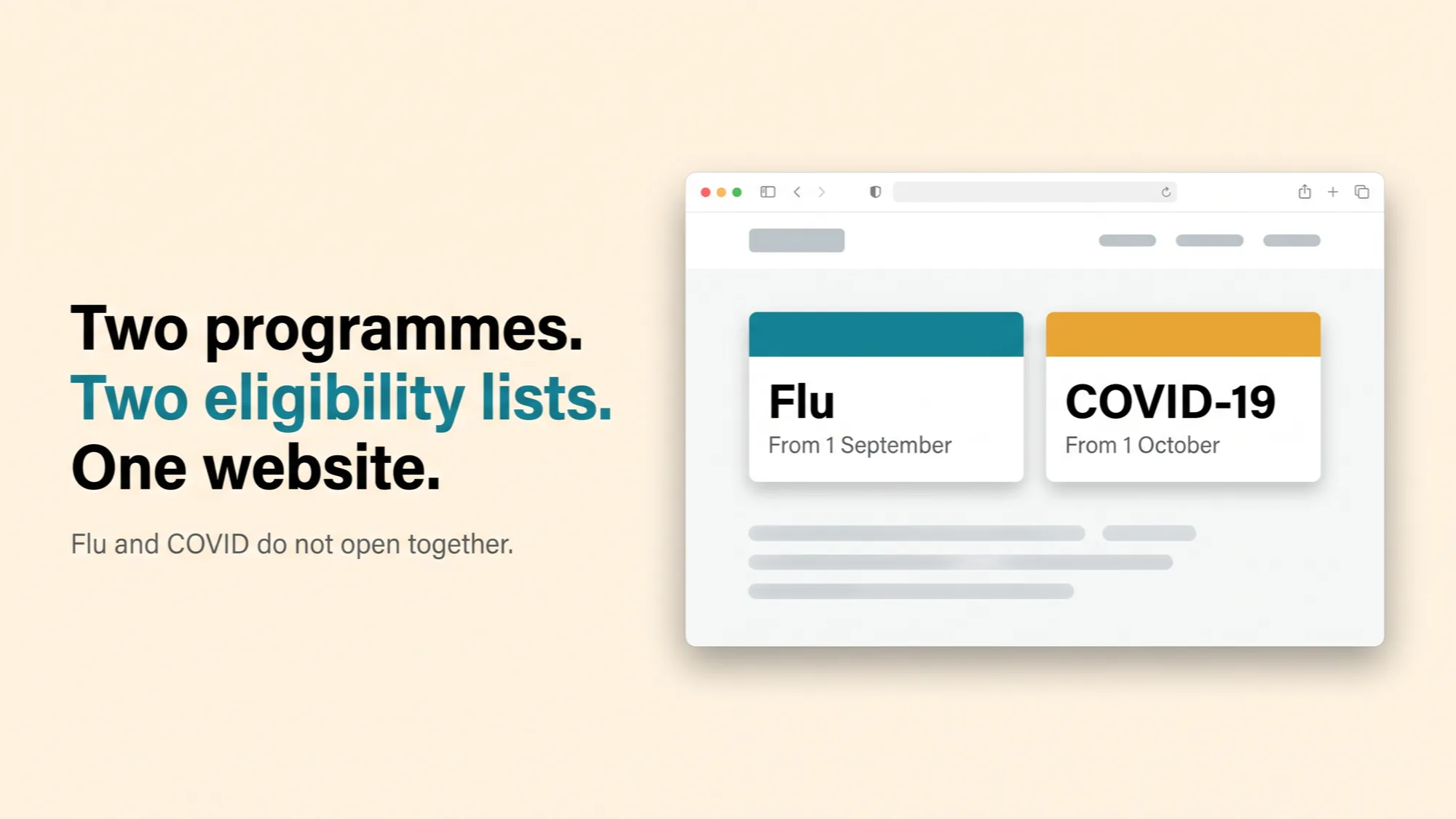
The autumn vaccination season is the busiest fortnight of the year for a practice website, and almost none of it is clinical. It is clinic dates, eligibility, booking links, walk-in sessions and a steady trickle of corrections as supply moves. This year there is more of it than usual, because two programmes run on different clocks and one of the booking routes is new.
Here is what a practice website has to carry between now and March, in the order the dates arrive.
Four dates, two programmes
1 September 2026: flu opens for the first cohorts
The national flu programme begins for children, pregnant women and some adults, or as soon as vaccine supply allows. Eligible groups are unchanged from last season, which is a small mercy: last year’s eligibility wording can stay, provided somebody checks it rather than assuming.
1 October 2026: everyone else, and COVID begins
The remaining flu cohorts open, including adults aged 65 and over. On the same day the autumn COVID-19 programme starts, and this is where practice pages most often go wrong. The two programmes do not share an eligibility list. COVID this autumn is far narrower: adults aged 75 and over, and people aged six months and over who are immunosuppressed. A page that treats flu and COVID as one offer will send a 67 year old to a COVID appointment they are not eligible for.
30 November 2026: the expected finish line
NHS England expects the vast majority of flu vaccinations to be completed by this date. In practice it is the point at which website messaging should shift from “book your appointment” to “there is still time”, and most practice sites never make that change at all.
31 January and 31 March 2027: the two endings
The COVID programme closes on 31 January 2027. The flu programme runs on to 31 March 2027. Two endings, two months apart, on a page that usually has one “this season” heading.
The booking route that is new this year
GP practices can use the National Booking Service for flu this autumn, which opened on 17 August 2026. Patients can self-book through it or by calling 119.
That gives most practices a genuine decision rather than a default: your own online booking, the National Booking Service, a phone line, or some combination. Whichever you choose, the website has to say so unambiguously. The commonest failure we see is not a missing booking link, it is two of them on the same page with nothing to explain which one a patient should use.
Your flu page is your most accessible page, or it should be
This is the part worth dwelling on. Think about who reads a flu page: adults over 65, people who are immunosuppressed, pregnant women, carers. It is read disproportionately by the people most likely to be using larger text, higher contrast, a screen reader or a phone held at arm’s length.
So the autumn page is the one where accessibility stops being a compliance exercise, of the kind we covered in getting a website ready for a CQC inspection, and starts being the actual job. A few things that consistently fail on flu pages:
- Clinic dates inside an image or a PDF. A poster is quick to publish and invisible to a screen reader. If the dates exist only in a picture, a portion of your most eligible patients cannot read them.
- Colour alone carrying meaning. Green for available and red for full is not enough on its own.
- “Click here” booking links. Read out of context by a screen reader, a page of “click here” tells the patient nothing about which clinic they are booking.
- Tables built for a desktop. Most patients will read this on a phone. A clinic timetable that needs sideways scrolling is a timetable that will not be read.
If you would like this checked rather than guessed at, our free website audit scores a practice site against NHS England’s benchmarking tool and WCAG 2.2 AA, and the autumn pages are worth putting through it before the traffic arrives rather than after.
The practices who cannot make these changes
There is a group of practices for whom none of the above is straightforwardly available, and the timing is unkind.
If your website runs on My Surgery Website, FPM Group’s discontinuation notice states that it “will not provide site updates or support beyond the later of your agreement expiry or 1 September 2026”. For most practices on that platform, the day the flu programme opens is the day the website stops changing. Clinic dates, a revised eligibility line, a new booking link, a correction when supply moves: from that date, under the terms MSW has published, those stop being things it will do.
The site stays online and patients still reach it. It simply stops being able to tell them anything new, for the whole of the season it matters most. We have set out what the notice says, and what to do before the date, in what actually changes on 1 September.
A short list for the next fortnight
- Separate flu and COVID eligibility on the page. Different dates, different cohorts. Two sections, not one.
- Check last season’s wording before reusing it. Flu cohorts are unchanged; COVID cohorts are not.
- Decide your booking route and say it once. Own system, National Booking Service, or 119, with one clear instruction rather than competing links.
- Get the dates out of the poster and into text. Keep the poster if you like it, but the dates need to exist as readable words too.
- Agree who can edit the page in a hurry. Supply moves and clinics get rescheduled. The practical question is not whether the site can be changed, it is who can change it on a Friday afternoon and how long it takes.
- Diary 30 November and 31 January. Two dates when the page needs revisiting, both of which are usually missed.
The wider point
Flu season is the clearest annual test of whether a practice website is a working tool or a brochure that happens to be online. It is the one time of year when the information has to be right this week rather than broadly right, when it changes at short notice, and when the people reading it are the least able to cope with a page that is wrong.
A website that can be changed quickly, by the practice, without raising a ticket and waiting, is not a luxury in September. It is what our support arrangement exists to make ordinary. It is the difference between a patient turning up on the right day and a receptionist spending the morning on the phone explaining that the page is out of date. If that is not what your current arrangement gives you, it is worth a conversation before the season rather than during it.
Programme dates and eligible cohorts above are taken from NHS England’s published guidance for the 2026/27 flu and COVID-19 vaccination programmes, correct at the time of writing. Local arrangements vary, so check your own commissioning position before publishing anything.