







When a CQC inspection is coming, practices rehearse everything: the policies, the fridge logs, the significant-event folder. The website rarely makes the list. Yet your website is often the first thing an inspector sees, long before they set foot in the building, and it is the one part of your practice every patient inspects daily.
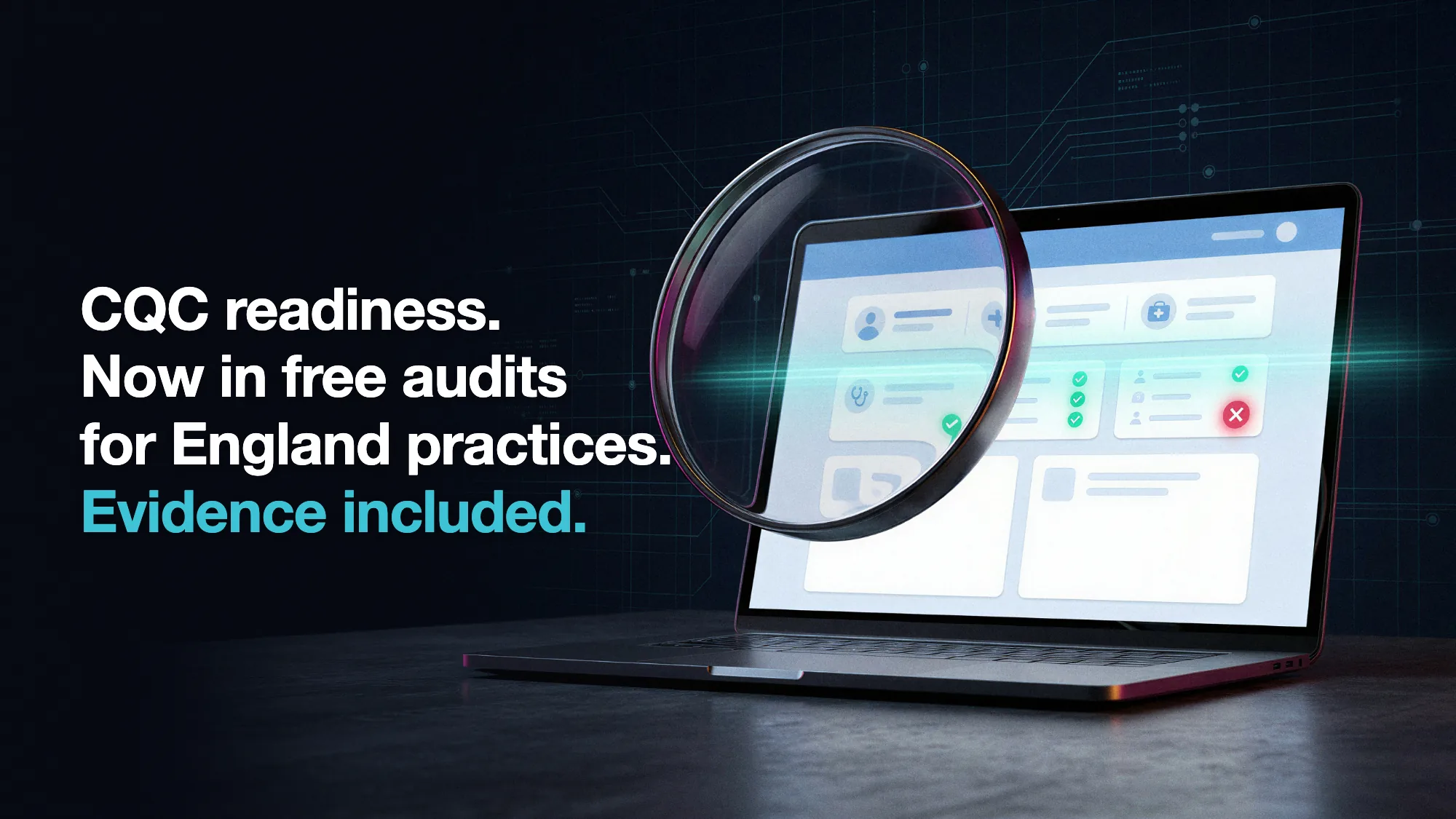
That is why our free website audit now includes something we believe no other GP website audit offers: a CQC readiness layer, run automatically on every full audit of an England practice.
The Legal Requirement Hiding in Plain Sight
Here is the check that surprises almost everyone. If your practice has a CQC rating, displaying that rating on your website is not good practice or a nice-to-have: it is a legal requirement. Regulation 20A of the Health and Social Care Act 2008 (Regulated Activities) Regulations 2014 requires providers to display their current rating on every website they operate. CQC’s guidance expects the new rating to be on display within 21 days of a new inspection report.
Our audit checks this properly. It recognises the official CQC widget, the official “Inspected and rated” badge, and hand-built rating displays, and it knows the difference: it will even spot a retired old CQC widget that silently renders nothing at all. Where your website links to your own profile on cqc.org.uk, the audit goes further and verifies the rating you display against CQC’s live register, using CQC’s own public data. That catches the case that stings the most: a website still showing the old rating weeks after a re-inspection changed it.
And because telling you is not the same as showing you, the audit photographs your rating display on the page as it found it, so your report carries the evidence, not just the verdict.
The Complaints Check Most Practices Fail
CQC’s GP mythbuster 103 covers a detail that sounds small and is anything but: patients may complain to the practice, or to the commissioner (their local ICB), but not to both about the same matter. CQC’s own guidance notes this is commonly misstated in practice policies, and our testing so far bears that out: most of the practices we have run the check on have needed a fix.
The audit reads your complaints page and checks the either/or route is stated, with the right commissioner named. If something needs changing, your report says exactly what, with wording direction that names your actual ICB rather than a generic template.
Accessible Information, Checked Too
The third check covers NHS England’s Accessible Information Standard: does your website tell patients how to get information in large print, easy read, braille or audio? Can they see how to request a BSL or other interpreter, and how to have their communication needs recorded? These are the practical questions the standard exists to answer, and your website is where patients look first.
Your Website Through an Inspector’s Eyes
Alongside the three checks, every report now includes a section that regroups the whole audit’s findings under the five questions every CQC assessment asks: safe, effective, caring, responsive, and well-led. Each item carries a one-line reason an inspector would care, so nothing needs decoding.
It is honest by design. Where a question cannot be evidenced from a website, the report says so plainly: caring, for instance, is assessed in person, and no website check can speak to it. And to be completely clear, none of this predicts a CQC rating or an inspection outcome. It shows you what an inspector would see on your website, which is exactly the part you can fix before they look.
A Check We Believe No One Else Runs
As far as we can tell, no other GP website audit tool checks the Regulation 20A rating-display requirement, and it is not part of NHS England’s own benchmarking tool either. It sits in that awkward gap between web guidance and regulation, which is precisely why we built it in.
One honest boundary: this is the website side of CQC readiness, not the whole of it. CQC assesses far more than any website can show, and these checks apply to England, where CQC regulates. For practices in Scotland, Wales and Northern Ireland, the five UK-wide areas of the audit (reading age, accessibility, performance, link health and security) still apply in full.
Free, and Already Included
There is nothing to request separately and nothing to pay: the CQC readiness layer now runs on every full audit of an England GP practice, alongside the six scored areas we already check (NHS England benchmarking, reading age, WCAG 2.2 accessibility, performance, link health and security).
If an inspection is on the horizon, or you simply want to know where your website stands, request your free audit. It takes about a minute, a person reviews every request, and your report arrives within one working day.