
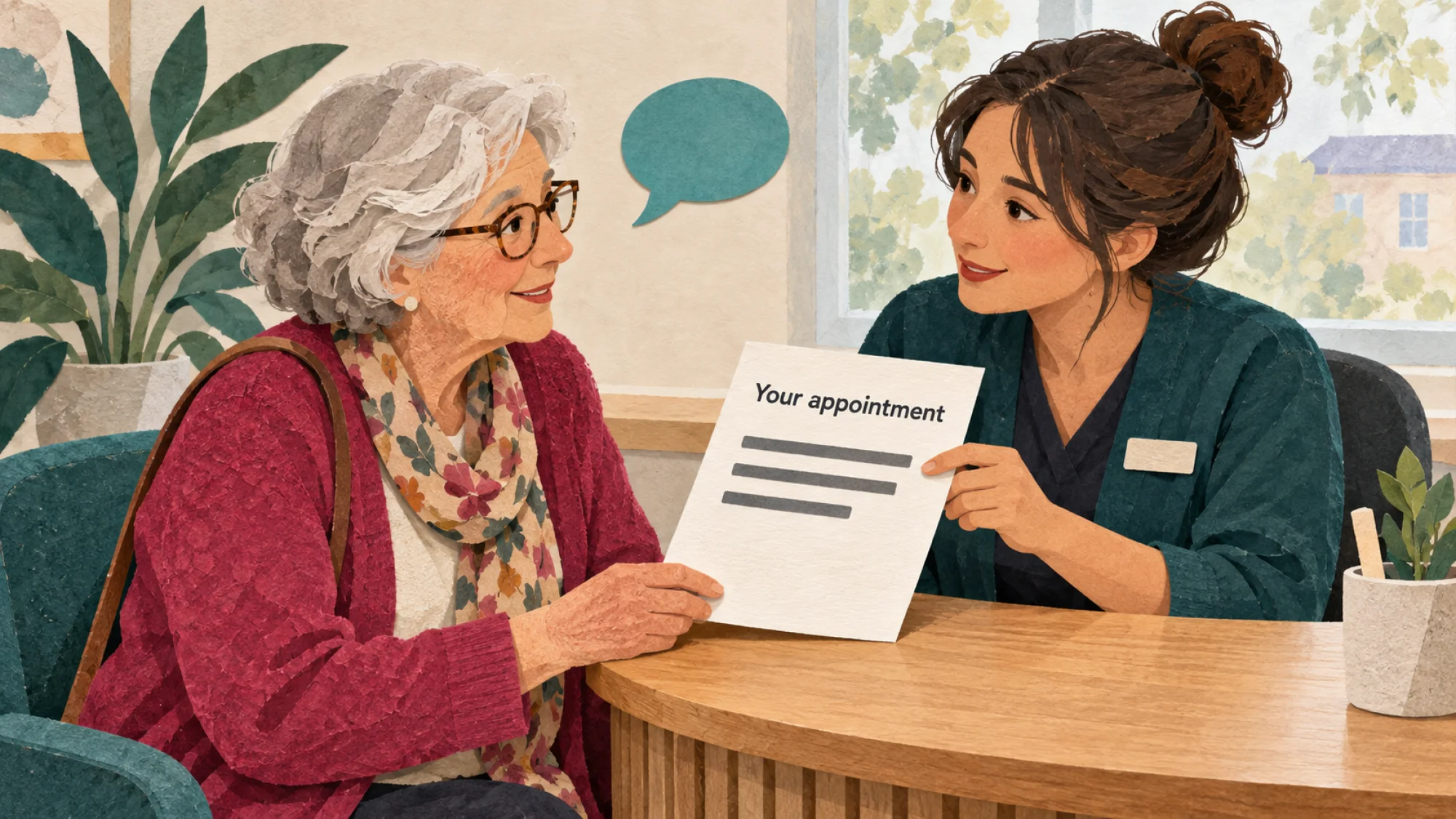
A patient tells your practice they cannot read standard-size letters. Your team records that they need large print. A month later, their next appointment letter arrives in the usual small type.
Would an Easy Read leaflet on the website have prevented that? Probably not. The information was recorded, but it did not change what the patient received.
Our support lead, Adrian Terry, raised this after practices asked whether the NHS Accessible Information Standard (AIS) meant filling their websites with PDFs. It is an understandable confusion: patient communication, accessible documents and website accessibility often get discussed together.
A collection of downloads does not demonstrate that you are meeting patients’ communication needs. Here is how the responsibilities fit together for GP practices in England.
What does the Accessible Information Standard actually require?
The NHS Accessible Information Standard, DAPB1605, concerns information and communication needs related to a disability, impairment or sensory loss. It also covers relevant needs of carers and family members involved in someone’s care. The aim is information people can understand and the support they need to communicate.
NHS England’s six implementation steps provide a useful way to think about the work:
- Ask: find out what help the person needs.
- Record: enter the specific need clearly in their record.
- Flag: make it visible when staff need to act.
- Share: pass relevant needs on through appropriate care and referral processes, following information-sharing and consent requirements.
- Act: provide information and communication support that meets those needs.
- Review: check whether the needs or arrangements have changed.
If your checklist still has five steps, the revised standard published in June 2025 added review as the sixth. A record needs to remain useful as someone’s circumstances change.
Follow one letter from the record to the patient
Take our opening example. “Visual impairment” tells a colleague something about the patient, but not necessarily what to do. A clear record of the large-print requirement gives them an action to take.
The next question is whether the appointment process uses that information. Does the system generate an appropriate letter, or does an alert prompt someone to arrange it? What happens when the usual member of staff is away? Has the patient confirmed that the result works for them?
This is an illustrative example, not a report about a particular practice. It shows why the useful test is the information the patient receives, rather than the number of files you have uploaded.
Do we need PDFs and Easy Read versions of everything?
No. NHS England’s implementation guidance explains that organisations do not have to offer every alternative format. They need arrangements to provide a suitable format promptly when it is needed, and should keep commonly used information in commonly needed formats ready.
Easy Read can be valuable and sometimes necessary. So can large print, audio, accessible digital text or communication support such as a British Sign Language interpreter. These are different ways of meeting different needs. A PDF is simply a file format; it is not automatically accessible or Easy Read.
Keep resources that help your patients. The point is to choose and deliver them purposefully, not to remove useful alternatives or wait until someone struggles. Equally, sending everyone to a download page will not help a person who cannot use it. The guidance requires an appropriate alternative where online information is unsuitable for the individual.
Where do the website accessibility rules fit?
Website accessibility is a connected but separate responsibility. NHS England’s implementation guidance distinguishes AIS from the regulations governing websites and apps. A technically accessible website cannot, on its own, make sure an appointment letter or a consultation meets someone’s needs.
GOV.UK’s accessibility guidance sets out the public-sector website requirements: WCAG 2.2 AA and a published, up-to-date accessibility statement, subject to the regulations’ exemptions. Equality Act duties to make reasonable adjustments also remain relevant. Outsourcing a website does not transfer the organisation’s legal responsibility to its supplier.
In everyday terms, check whether patients can read your content, navigate with a keyboard and use your forms with assistive technology. Our guide to WCAG 2.2 for GP websites explains the website side in more detail.
What should we put on the practice website?
Start with clear web pages for information people need regularly. The Government Digital Service recommends publishing in HTML wherever possible: ordinary web content can work with a reader’s browser settings and avoids many of the difficulties associated with PDFs. The page still needs to be built and written accessibly.
- Make help easy to find. Explain how patients can tell you about communication needs or request information in another format. Offer contact routes your team can genuinely support.
- Describe your approach. Make your accessible communication policy available. This explains how you meet individual needs; your website accessibility statement explains the accessibility of the website itself.
- Review downloads before adding more. Could this be a web page? If a document is needed, check its headings, reading order and accessibility rather than assuming a PDF export is enough.
- Keep useful alternatives current. An accessible leaflet with an old telephone number still creates a problem.
The standard also includes organisational assessment and improvement work. A helpful website supports that work; it does not replace it. NHS England’s requirements explain the expectations for publishing your accessible communication policy and improvement plan.
A useful question for your next practice meeting
Ask: “If a patient tells us today that they need large print, what makes sure their next letter arrives that way?” Walk through the answer together, including reception, administration and anyone who sends correspondence. Then check whether your website makes it easy to ask for help.
At Tree View Designs, we can help with the website part: clear patient information, accessible pages and reviewing how downloads are used. Your practice leads the recording and delivery of individual communication needs. Existing customers can contact our support team about a page they are unsure of. If you want a starting point for the website itself, request a free GP website audit. It is a website review, not certification of your practice’s overall AIS compliance.