
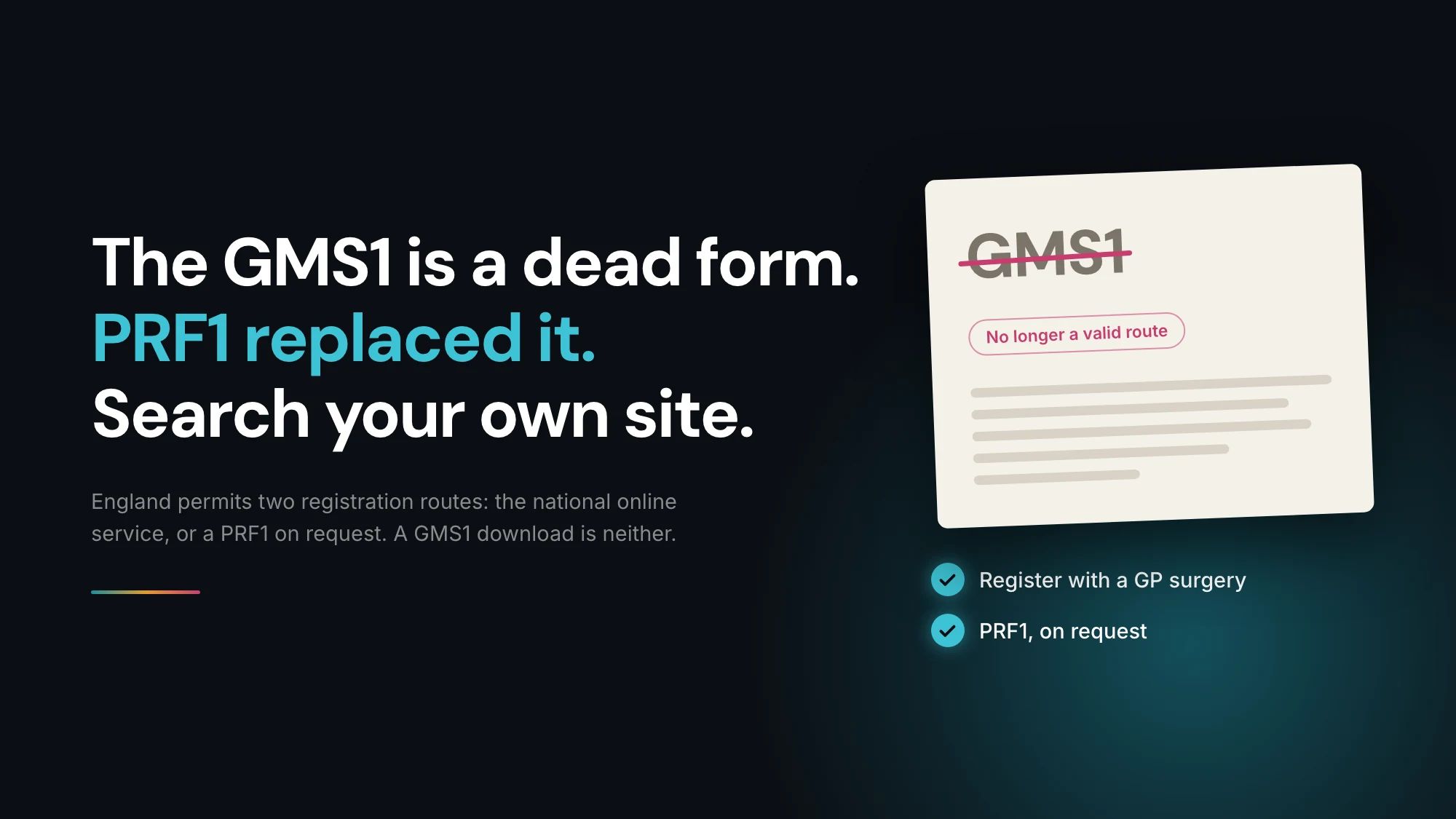
If your practice website still offers patients a GMS1 to download, or a registration form built by your website provider, that is no longer a valid way for someone to join your list. This is not a matter of preference or best practice. In England the regulations permit two routes only, and neither of those is one of them. A fair number of practice websites still lead with one of them.
This is a plain account of what changed, what a registration page is now expected to do, and seven things worth checking on your own before the autumn intake arrives.
A scope note before anything else. The contractual position, the PRF1 form and the national online service are England only. Practices in Wales, Scotland and Northern Ireland have their own arrangements and should ignore the legal sections here. The craft points further down, about findability, proof of address, catchment accuracy and accessible forms, apply everywhere.
What actually changed, in three steps
The rules moved three times in under two years, which is why so many pages are out of date. In England:
- From 31 October 2024, a practice may only accept a registration application by one of two routes: a form specified by NHS England, or the national online registration service. The regulations require practices to make both available.
- From 21 July 2025, integrated care boards may set circumstances in which out of area applications need commissioner approval first.
- From 15 June 2026, where a practice receives a paper application it must submit that information through the online service too, unless its clinical system cannot connect. Paper is still offered. It now goes through the same online service.
Two consequences follow, and both live on your website rather than in your clinical system.
The GMS1 on your site is a dead form
In England the GMS1 has been replaced by the PRF1, which mirrors the questions in the online journey and exists for patients who cannot or will not use the online route. GMS1 has been decommissioned and is no longer orderable. A page still offering a GMS1 download is handing people a form that no longer has standing.
Your provider's own web form is not a registration route
This one catches practices out, because the form usually works, looks tidy and has been there for years. If the regulations permit only the specified form or the national service, then a bespoke form built by a website company is neither. NHS England guidance says it plainly: remove existing links to legacy website provider webforms and practice-generated downloadable forms.
If you are not certain which of these your own site uses, that is the single most useful thing to establish this week.
The link most practices have, and few use well
When a practice signs up through NHS Profile Manager it receives a unique link to its own registration journey, for adding to its website. Patients can also reach the service through the NHS website and the NHS App, so your own site is one of three doors rather than the only one.
That cuts both ways. A poor registration page does less damage than you might fear, because patients have other ways in. It also means most practices never think to check theirs, because nothing obviously breaks when they do not.
The service is now the default nationally. As at August 2026, 99.6% of practices in England use it, and it carried 80.8% of registrations over the preceding three months, with 9.4 million submissions since launch. Average completion takes just under twelve minutes.
Two numbers from the national data are worth pinning above a practice manager's desk. 48% of registrations are submitted outside surgery opening hours. And roughly one in fifteen people using it did so in a language other than English. Between them, those two numbers describe someone your reception team will never meet.
Proof of address and ID: what your page is allowed to say
This is where practice websites go wrong most often, and where the wording carries the most weight.
A practice may ask for identification. It may not require it as a condition of registration. NHS England's registration principles are explicit that inability to provide identification or proof of address is not reasonable grounds to refuse to register someone. The BMA puts it as directly as it can: there is no contractual duty to seek evidence of identity, immigration status or proof of address, and practices should not refuse registration because a patient cannot produce it. Immigration status makes no difference to entitlement, and practice staff are not expected to assess it.
The distinction that keeps a practice safe is a narrow one. Living outside your area is a reasonable ground to refuse. Being unable to prove an address is not.
Where the ID habit comes from
It is worth understanding why so many practices believe ID is required, because the belief is not invented. For years the identity check that mattered had nothing to do with registration. It was about giving a patient online access to their record, through Patient Access or whichever system the practice used, and that check genuinely did require photo identification. It was almost always done on the day someone joined the list, because that was the one moment a patient was standing at the desk with documents in hand. Two separate processes happened at the same counter on the same afternoon, and over time they merged. Ask most practices why the page says "please bring photo ID" and the truthful answer is that it has always said it.
That justification has gone. Identity verification for online access now sits with NHS login, where patients verify themselves using their own documents, and someone already verified for GP online services can carry that check across rather than repeat it. It is no longer something your front desk does.
Proxy access is going the same way. Family and carer access in the NHS App lets a person apply on behalf of someone else through the app, and NHS England is extending it to more practices through 2026 with the stated intention that it reaches every practice in England. Be precise about what that changes, though: the application moves into the app, while the practice still decides whether proxy access is safe, necessary and relevant, and still sets it up in the clinical system. The paperwork moves. The judgement does not.
The consequence for your website is a narrow one. If the ID sentence on your registration page was written to support a verification step that no longer happens at your practice, it is asking patients for documents in service of nothing, on the one page read by people who are not yet on your list.
There is published evidence that websites are where this goes wrong. A study in the British Journal of General Practice reviewed 100 London practice websites and found 75 asked for documentation of some kind. Sixty-five mentioned photo identification, of which 33 presented it as required, 21 as a request and 11 in passing. Seventy-two mentioned proof of address, 39 of them as a requirement. Of the 75 sites asking for documents, only 12 offered any alternative for people who had none.
That last figure is the one to sit with. Asking is permitted. Asking with no stated alternative is what turns a web page into a barrier, and it is inconsistent with what NHS England expects an identification policy to contain, which includes what happens when a patient has no documents at all.
Seven things to check on your own page
- Is the national service the first thing offered? Not the third option under a heading about opening hours. If a patient has to read past a paragraph to find it, it is buried.
- Is there a GMS1 link anywhere? Search your own site for it. In England it needs replacing with PRF1, or with nothing at all if the online route plus an offer of a paper form on request is clearer.
- Is there a bespoke registration form? If your website has its own form that emails reception, that is not one of the two permitted routes in England.
- What does the page say about ID? If it lists documents with no sentence covering people who have none, that sentence is the fix, and it is one sentence. Worth asking why the list is there at all: if it was written to support online access, that verification now happens through NHS login rather than at your desk.
- Is the catchment information current and readable? Address checking now happens inside the service, so a stale boundary description on the page creates contradictions rather than clarity.
- Does the page work on a phone, and does it read plainly? Half these submissions arrive out of hours, which overwhelmingly means a phone, often at speed, sometimes not in the reader's first language.
- Is there one route, or three competing ones? The commonest failure is not an absent link. It is an online link, a downloadable form and an instruction to come to reception, all on one page, with nothing to say which a patient should use.
Our free website audit checks a practice site against NHS England's benchmarking tool and WCAG 2.2 AA, and the registration page is one of the places it most often finds something worth fixing. It sits alongside the CQC checks we added earlier this summer.
Why now
Late September is when this page is tested hardest. Students arrive, people who moved over the summer get round to it, and anyone whose registration lapsed during a house move finally deals with it. It is the heaviest new-patient traffic of the year, arriving at the one page written for people who are not yet on your list and therefore cannot ring you as a patient to ask.
It also arrives immediately after the autumn vaccination programmes open, which we covered in what a practice website has to carry through flu season. Between the two, September and October ask more of a practice website than any other stretch of the year.
The part that has nothing to do with regulations
A registration page is the only page on a practice website read almost entirely by people who are not yet your patients. Everyone else arriving has a relationship with you already. These readers do not, and a page that is confusing, or that reads as a list of conditions to satisfy, is the whole impression they have of the practice.
It costs nothing to say plainly what you need, what happens if someone hasn't got it, and how long a decision takes. Most pages say the first and skip the other two.
If you would like us to look at yours, or you are not sure which registration route your current site actually uses, ask us and we will tell you what we find either way.
Regulatory positions above are England only and taken from the GMS Regulations 2015 as amended, NHS England guidance and BMA guidance, correct at the time of writing. Your integrated care board may set additional local arrangements, particularly on out of area registration, so check yours before changing published wording.